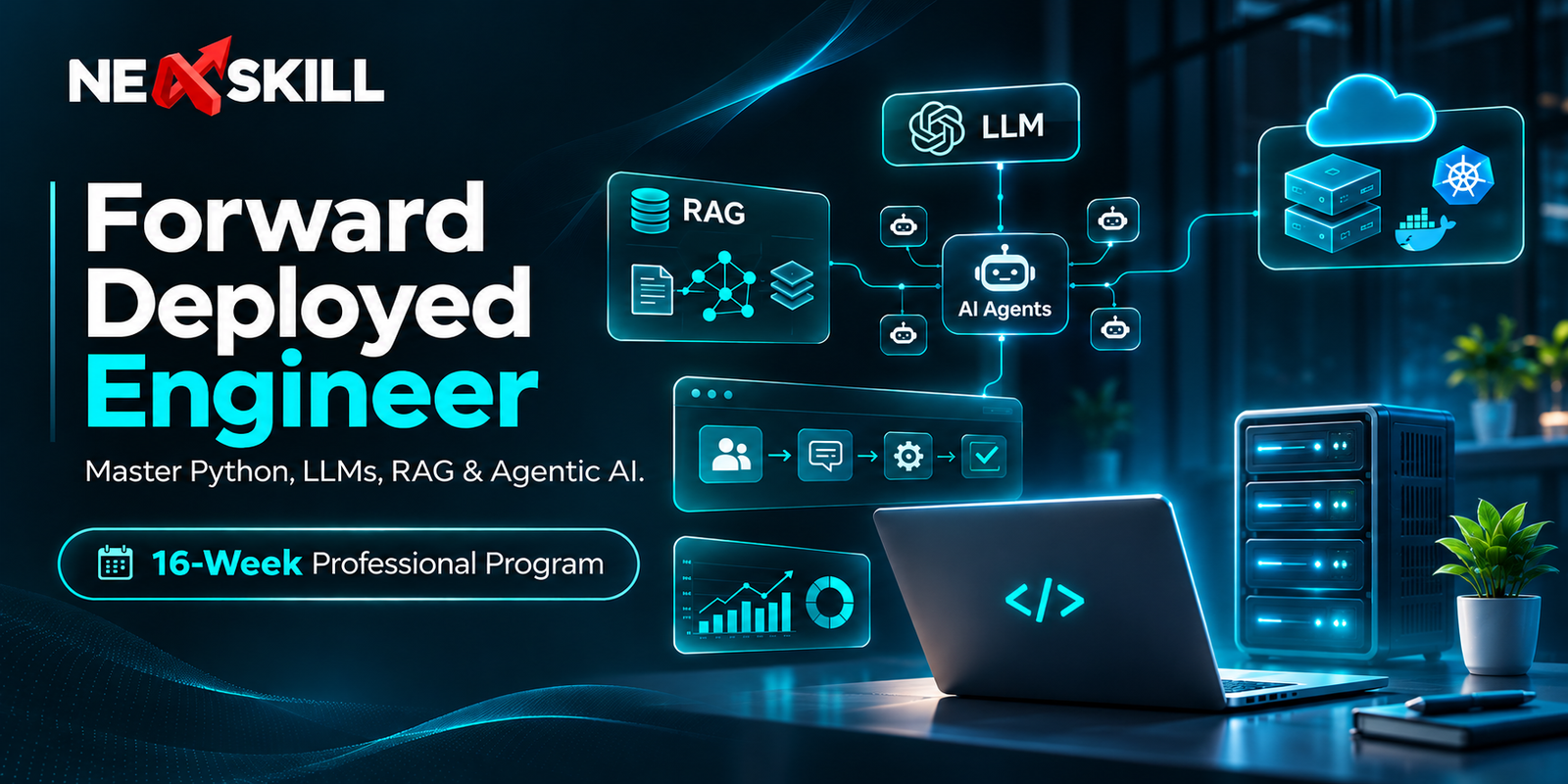
Become a certified Forward Deployed Engineer with Nexskill's comprehensive 16-week professional program. Master Python, LLM APIs, RAG engineering, Agentic AI, MCP, Docker, CI/CD, and cloud deployment to build and deliver production-ready AI solutions.
Course Flow or Roadmap
Kickstart your career with Nexskill's Forward Deployed Engineer course in Lahore. This intensive 16-week program provides hands-on experience in Python programming, AI application development, large language models, retrieval-augmented generation, agentic AI systems, and production deployment. Start with Claude and no-code AI tools before progressing into Python fundamentals, advanced programming, Git, GitHub, and AI-assisted coding with Claude Code and Cursor. Learn to integrate Claude and Gemini APIs, build structured AI applications, engineer advanced RAG systems with LangChain and LlamaIndex, and develop intelligent agents using LangGraph, PydanticAI, Microsoft AutoGen, and Google ADK. You will also master MCP and A2A protocols, Docker containerization, GitHub Actions CI/CD, AWS, and Google Cloud. With 48 practical classes across 8 professional modules, this program prepares you to design, build, deploy, and deliver production-ready AI solutions for real businesses.
Module Topics
A Forward Deployed Engineer (FDE) works directly with businesses and clients to understand technical challenges, design intelligent solutions, and deploy production-ready software systems. Unlike traditional developers who work only on isolated features, Forward Deployed Engineers combine software engineering, AI development, system integration, and client collaboration. They build applications using Python and modern LLM APIs, develop RAG systems that connect AI models to private business knowledge, and create intelligent agents that interact with external tools and services. They also manage application infrastructure using Docker, CI/CD pipelines, AWS, and Google Cloud. Forward Deployed Engineers translate real business requirements into practical AI-powered solutions, ensuring systems are secure, scalable, reliable, and ready for production.
Course Curriculum Overview
1Module 1: Claude & No-Code AI — Weeks 1–3
2Module 2: Python for AI — Weeks 4–6
3Module 3: Git, GitHub & AI-Assisted Coding — Week 7
4Module 4: LLM APIs & Structured Outputs — Weeks 8–9
5Module 5: RAG Engineering — Weeks 10–11
6Module 6: Agentic AI & Protocols — Weeks 12–13
7Module 7: Docker, CI/CD & Cloud Deployment — Weeks 14–15
8Module 8: Ship, Deliver & Capstone — Weeks 15–16
Course Duration & Mode
Duration: 16 Weeks (4 Months)
Total Classes: 48
Classes Per Week: 3
Modules: 8
Modes: Online & Physical
Campuses: Available at Participating Nexskill Campuses
Sessions: Weekday & Weekend Batches Available
Comprehensive Course Modules
1Module 1: Claude & No-Code AI — Weeks 1–3
Module 1
2Module 2: Python for AI — Weeks 4–6
Module 2
3Module 3: Git, GitHub & AI-Assisted Coding — Week 7
Module 3
4Module 4: LLM APIs & Structured Outputs — Weeks 8–9
Module 4
5Module 5: RAG Engineering — Weeks 10–11
Module 5
6Module 6: Agentic AI & Protocols — Weeks 12–13
Module 6
7Module 7: Docker, CI/CD & Cloud Deployment — Weeks 14–15
Module 7
8Module 8: Ship, Deliver & Capstone — Weeks 15–16
Module 8
Who Should Attend?
Nexskill offers this professional Forward Deployed Engineer program with flexible enrollment and payment options. Contact the admissions team for the latest fee structure, available batches, installment plans, and enrollment details. Some third-party AI tools, API usage, and cloud infrastructure services may require separate subscriptions or usage credits.
Detailed Weekly Learning Schedule
📅 Schedule: 2 Interactive Sessions Per Week
Total Lectures: 48 | Duration: 2 hours each
Module 1: Claude & No-Code AI
Weeks 1–3 · Classes 1–9Learning Objectives:
- •Class 1 — Meet Claude & Claude.ai
- •Introduction to Anthropic
- •Understanding the Claude Model Family
- •Choosing Models for Quality, Speed and Cost
- •Claude Chat, File and Data Analysis
- •Projects and Knowledge Management
- •Memory, Web Search and Deep Research
- •Class 2 — Advanced Prompt Engineering
- •Clear Instructions and Context
- •Roles and System Prompts
- •Few-Shot Examples
- •XML Tags and Structured Prompts
- •Chain-of-Thought Concepts
- •Prompt Chaining and Reusable Templates
- •Class 3 — Artifacts, Docs & Design
- •Interactive Artifacts and Published Apps
- •Claude Docs and File Creation
- •Claude Design
- •Landing Pages and Mockups
- •AI-Generated Creative Assets
- •Class 4 — Claude in Your Tools
- •Gmail, Google Drive and Calendar Connectors
- •Claude in Chrome
- •Claude with Excel and PowerPoint
- •Claude Tag for Slack
- •Permissions and Privacy
- •Class 5 — Agent Skills & Cowork
- •Understanding Agent Skills
- •SKILL.md Structure
- •Custom Skills for Business Processes
- •Claude Cowork for Multi-Step Knowledge Work
- •Building Repeatable Workflows
- •Class 6 — n8n Automation
- •Automation Workflows and Triggers
- •Webhooks and API Integrations
- •Connecting External Services
- •Claude and Gemini AI Nodes
- •Make and Zapier Compared
- •Class 7 — Lovable
- •Prompt-to-App Development
- •Supabase Database Integration
- •Authentication and Storage
- •Adding AI Features
- •Custom Domains and Deployment
- •Class 8 — Bolt, v0 & Replit
- •Comparing AI Application Builders
- •Building Applications with Bolt
- •UI Development with v0
- •Design-to-Code from Screenshots and Figma
- •Platform Strengths and Limitations
- •Avoiding Vendor Lock-In
- •Class 9 — Google Stitch & AI Studio
- •AI UI Design from Prompts and Sketches
- •Multi-Screen Application Flows
- •Figma and Code Export
- •Google AI Studio Playground
- •Building AI Applications with Gemini
Module 2: Python for AI
Weeks 4–6 · Classes 10–18Learning Objectives:
- •Class 10 — Setup, Syntax & Control Flow
- •Installing Python and VS Code
- •Variables and Data Types
- •Operators and Expressions
- •if, elif and else Statements
- •For and While Loops
- •Break and Continue
- •Class 11 — Functions & Data Structures
- •Functions and Parameters
- •*args and **kwargs
- •Lambda Functions
- •Lists, Tuples and Sets
- •Dictionaries
- •List and Dictionary Comprehensions
- •Class 12 — Strings, Files & Environments
- •String Manipulation
- •Regular Expressions (Regex)
- •File Handling
- •Exception Handling
- •Modules and Packages
- •Virtual Environments
- •Poetry and pip
- •Class 13 — OOP Foundations
- •Classes and Objects
- •Constructors
- •Single Inheritance
- •Multiple Inheritance
- •Method Resolution Order (MRO)
- •Encapsulation and Private Attributes
- •Class 14 — OOP Advanced & Type Hints
- •Polymorphism
- •Duck Typing
- •Abstract Base Classes
- •Dataclasses and Immutability
- •Type Hints
- •Static Type Checking
- •Class 15 — Advanced Python Mechanics
- •Iterators and Iterable Protocol
- •Generators and yield
- •Decorators
- •Stateful Decorators
- •Custom Context Managers
- •Class 16 — Async Python
- •asyncio Event Loop
- •Async and Await Patterns
- •Task Management
- •asyncio.gather
- •Semaphores
- •Non-Blocking API Calls
- •Class 17 — APIs & Your First LLM Call
- •HTTP and REST Fundamentals
- •JSON Data Handling
- •Environment Variables and .env
- •Calling the Claude API from Python
- •API Response Handling
- •Converting an n8n Workflow into Python Code
- •Class 18 — Python Project Structure
- •Project Layout and Packaging
- •Logging and Configuration
- •Testing with pytest
- •Reusable Python Modules
- •Mini Project: Command-Line AI Assistant
Module 3: Git, GitHub & AI-Assisted Coding
Week 7 · Classes 19–21Learning Objectives:
- •Class 19 — Git & GitHub
- •Git Fundamentals
- •Commits, Branches and Merges
- •Pull Requests and Code Reviews
- •Resolving Merge Conflicts
- •Professional README Files
- •Building a GitHub Portfolio
- •Team Collaboration Workflows
- •Class 20 — Claude Code
- •Terminal Setup
- •Claude Code Desktop and VS Code
- •Plan Mode
- •Exploring Existing Codebases
- •CLAUDE.md Configuration
- •Subagents, Hooks and Slash Commands
- •Creating Commits and Pull Requests with Claude Code
- •Class 21 — Cursor
- •AI-First Code Editing
- •Tab Autocomplete
- •Agent Mode for Multi-File Edits
- •@-Mentions and Codebase Context
- •Cursor Rules
- •Background Agents
- •Cursor vs Claude Code
Module 4: LLM APIs & Structured Outputs
Weeks 8–9 · Classes 22–27Learning Objectives:
- •Class 22 — Claude API & Platform
- •Claude Developer Console
- •API Keys and Workspaces
- •Python and TypeScript SDKs
- •Messages API
- •Streaming Responses
- •Vision and PDF Input
- •Token Counting
- •Class 23 — Tool Use & Function Calling
- •JSON Schema Tool Definitions
- •Understanding the Tool-Use Loop
- •Parallel Tool Calls
- •Server Tools: Web Search and Code Execution
- •Building a Tool Executor from Scratch
- •Class 24 — Structured Outputs
- •Pydantic Models as Data Contracts
- •Instructor with Automatic Retry
- •Outlines Guided Generation
- •Data Extraction Pipelines
- •Classification Pipelines
- •Structured Response Validation
- •Class 25 — DSPy Programmatic LLMs
- •DSPy Signatures and Modules
- •Predict
- •ChainOfThought
- •ReAct
- •BootstrapFewShot Optimizer
- •MIPROv2 Optimizer
- •Replacing Manual Prompt Tuning
- •Class 26 — Gemini API & Multi-Model Strategy
- •Gemini SDK
- •Multimodal Input
- •Function Calling
- •Claude vs Gemini Strengths
- •Multi-Model Application Architecture
- •Routing Tasks Between Models
- •Class 27 — Cost & Performance
- •Prompt Caching
- •Batch API for Bulk Jobs
- •Model Selection for Cost and Quality
- •Latency Optimization
- •FastAPI Backends for LLM Features
Module 5: RAG Engineering
Weeks 10–11 · Classes 28–33Learning Objectives:
- •Class 28 — Embeddings & Vector Search
- •Understanding Embeddings
- •Dense vs Sparse Embeddings
- •BGE and E5 Embedding Models
- •BM25 and SPLADE
- •Quantized Embeddings
- •Matryoshka Embeddings
- •Qdrant, Pinecone and PGVector
- •Class 29 — LangChain
- •Introduction to LangChain
- •LCEL Pipelines
- •Document Loaders
- •Text Splitters
- •Retrievers
- •Output Parsers
- •Tracing with LangSmith
- •Class 30 — LlamaIndex
- •Introduction to LlamaIndex
- •Documents and Nodes
- •Chunking Strategies
- •Index Types
- •Query Engines
- •Metadata Filtering
- •Hybrid Search
- •Class 31 — Advanced RAG
- •Hybrid Retrieval
- •Reciprocal Rank Fusion (RRF)
- •Query Rewriting
- •HyDE
- •Rerankers
- •Contextual Retrieval
- •Self-RAG
- •Corrective RAG
- •Agentic RAG
- •Class 32 — Multimodal & Graph RAG
- •Multimodal RAG Architecture
- •LlamaParse and Docling
- •Document Parsing
- •ColPali Visual Retrieval
- •Graph RAG
- •Neo4j Integration
- •Semantic Caching with Redis
- •Class 33 — RAG Evaluation & Security
- •RAG Evaluation Fundamentals
- •RAGAS Metrics
- •Faithfulness
- •Context Precision and Recall
- •LLM-as-Judge
- •PII Masking
- •Prompt Injection Defense at Retrieval
Module 6: Agentic AI & Protocols
Weeks 12–13 · Classes 34–39Learning Objectives:
- •Class 34 — Claude Agent SDK
- •Understanding the Agent Loop
- •Workflows vs Agents
- •Agent SDK Tools
- •Permissions and Sessions
- •Human-in-the-Loop Approvals
- •Connecting Agents to Skills
- •Class 35 — LangGraph Stateful Agents
- •Introduction to LangGraph
- •StateGraph
- •Nodes and Edges
- •Conditional Routing
- •ReAct Loops
- •Checkpointers and Memory
- •Context Management
- •Interrupts
- •Multi-Agent Supervisors
- •Class 36 — PydanticAI
- •Type-Safe Agents
- •Dependency Injection
- •Tool Error Handling with ModelRetry
- •Structured Streaming
- •Pydantic Evals
- •Logfire Tracing
- •Class 37 — Microsoft AutoGen
- •AgentChat
- •Assistant and User-Proxy Agents
- •Group Chats and Agent Teams
- •Tool Use and Code Execution
- •AutoGen Studio
- •Microsoft Agent Framework
- •Class 38 — Google Agent Development Kit (ADK)
- •LLM Agents and Tools
- •Sequential Workflow Agents
- •Parallel Workflow Agents
- •Loop Workflow Agents
- •Multi-Agent Hierarchies
- •Sessions and State
- •ADK Web UI and Evaluations
- •Vertex AI Agent Engine
- •Cloud Run Deployment
- •Class 39 — MCP & A2A Protocols
- •Understanding Model Context Protocol
- •Building MCP Servers with FastMCP
- •Connecting MCP to Claude
- •Claude Code and Cursor MCP Integration
- •MCP Security
- •A2A Agent Cards
- •A2A Task Lifecycle
- •A2A vs MCP
Module 7: Docker, CI/CD & Cloud Deployment
Weeks 14–15 · Classes 40–44Learning Objectives:
- •Class 40 — Docker Fundamentals
- •Docker Images and Containers
- •Writing Dockerfiles
- •Docker Volumes
- •Container Networking
- •Containerizing a FastAPI Application
- •Containerizing an LLM Application
- •Class 41 — Docker Compose & Production Images
- •Docker Compose Fundamentals
- •Multi-Container Applications
- •API and Database Containers
- •Vector Database and Redis Containers
- •Multi-Stage Builds
- •Environment and Secrets Management
- •Container Registries
- •Class 42 — GitHub Actions CI/CD
- •CI/CD Fundamentals
- •GitHub Actions Workflows
- •Workflow Triggers
- •Automated Tests and Linting
- •Building and Pushing Docker Images
- •Container Registries
- •Claude Code in GitHub Actions
- •Automated Code Review
- •Class 43 — AWS Deployment
- •AWS Infrastructure
- •Identity and Access Management (IAM)
- •Amazon EC2
- •Amazon S3
- •Amazon ECR
- •Amazon ECS and Fargate
- •Domains and HTTPS
- •Load Balancing
- •Cloud Monitoring and Cost Management
- •Class 44 — Google Cloud & Vercel
- •Google Cloud Fundamentals
- •Deploying Containers to Cloud Run
- •Frontend Deployment with Vercel
- •Supabase in Production
- •Choosing the Right Deployment Platform
- •Selecting Infrastructure for Clients
Module 8: Ship, Deliver & Capstone
Weeks 15–16 · Classes 45–48Learning Objectives:
- •Class 45 — Building & Launching an AI SaaS
- •Product Requirements Document (PRD)
- •MVP Scope and Feature Planning
- •Multi-Tenant Architecture
- •AI SaaS Application Development
- •Stripe Payment Integration
- •JazzCash and Easypaisa Integration
- •KuickPay Integration
- •Product Launch and Feedback Collection
- •Class 46 — Production Readiness & Client Delivery
- •Production Guardrails
- •Prompt Injection Defense
- •Observability with LangSmith
- •Observability with Langfuse
- •Client Discovery Calls
- •Professional Proposals
- •Project Scoping and Pricing
- •Selling on Upwork and Fiverr
- •Class 47 — Capstone Build
- •Selecting a Real Business Problem
- •Client Discovery
- •AI Solution Architecture
- •Building a Complete AI Solution
- •RAG Knowledge Base Development
- •AI Agent and MCP Integration
- •Docker Containerization
- •Cloud Deployment with GitHub Actions
- •Mentor Reviews and Improvements
- •Class 48 — Capstone Demo & Certification
- •Live Client-Style Demonstration
- •Presenting the Complete AI Solution
- •Professional Case Study
- •GitHub Portfolio Presentation
- •Practical Engineering Assessment
- •Forward Deployed Engineer Certificate Award
Learning Outcomes
Enroll Now — Online & In-Campus Batches Available! Join Nexskill's Forward Deployed Engineer program and learn to build intelligent AI applications, engineer advanced RAG systems, develop autonomous AI agents, and deploy production-ready solutions in the cloud. Complete 48 practical classes, build a real-world capstone, and earn the Forward Deployed Engineer Certificate.
Why Choose Nexskill?
Perfect For These Professionals
Students interested in Artificial Intelligence and software engineering
Python developers looking to specialize in AI engineering
Frontend and backend developers moving into AI development
Software engineers interested in LLM applications and RAG systems
Developers interested in Agentic AI and multi-agent architectures
Freelancers looking to deliver AI solutions to international clients
Entrepreneurs building AI-powered SaaS products
Technology professionals interested in cloud and production engineering
Beginners willing to learn programming and build a career in AI engineering
Course Fee & Enrollment
Skills You'll Master
✓
Master Claude, Claude Code, Cursor, and no-code AI development tools.
✓
Write production-style Python applications using OOP, decorators, generators, and asynchronous programming.
✓
Use Git, GitHub, Claude Code, and Cursor as everyday engineering tools.
✓
Build reliable AI applications using Claude and Gemini APIs.
✓
Implement function calling, tool use, streaming, and structured outputs.
✓
Use Pydantic, Instructor, Outlines, and DSPy for reliable AI responses.
✓
Build production RAG systems using LangChain and LlamaIndex.
✓
Implement embeddings, vector search, hybrid retrieval, reranking, and RAG evaluation.
✓
Develop AI agents using Claude Agent SDK, LangGraph, PydanticAI, Microsoft AutoGen, and Google ADK.
✓
Build MCP servers and understand A2A agent communication protocols.
✓
Apply AI security practices, guardrails, PII masking, and prompt injection defense.
✓
Containerize AI applications using Docker and Docker Compose.
✓
Automate testing and deployment using GitHub Actions CI/CD.
✓
Deploy AI applications to AWS, Google Cloud, and Vercel.
✓
Build and launch multi-tenant AI SaaS products with payment integrations.
✓
Deliver secure, production-ready AI solutions to real clients.
✓
Complete a professional capstone and earn the Forward Deployed Engineer Certificate.
Ready to Become a Forward Deployed Engineer?
Why Students Choose Nexskill
★
Structured 16-week professional Forward Deployed Engineer program
★
48 practical engineering classes across 8 modules
★
Industry-focused Python and AI engineering curriculum
★
Hands-on development with modern LLM APIs and AI frameworks
★
Advanced RAG and Agentic AI engineering experience
★
Practical training in MCP, A2A, and multi-agent architectures
★
Docker, CI/CD, AWS, and Google Cloud deployment training
★
Real-world AI application development and integration projects
★
Mentor-guided final capstone project
★
Freelancing, client communication, and professional delivery guidance
★
Professional GitHub portfolio and certification opportunities