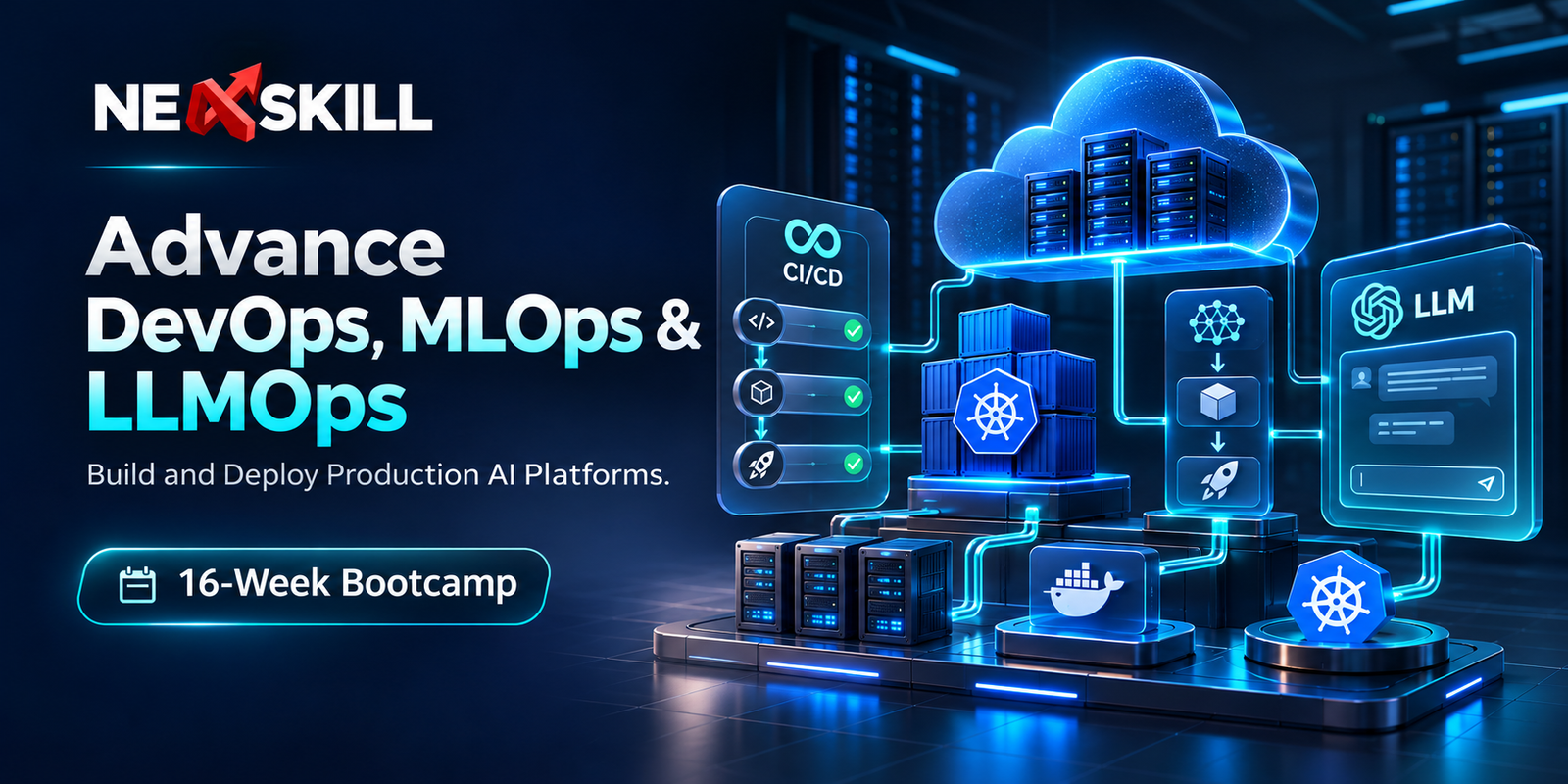
Become a certified DevOps, MLOps and LLMOps professional with Nexskill's comprehensive Advance DevOps, MLOps & LLMOps course in Lahore. Master Python, Linux, cloud infrastructure, Docker, Kubernetes, CI/CD, machine learning operations and production-grade LLM deployment through practical, industry-focused training.
Course Flow or Roadmap
Kickstart your career in modern infrastructure and AI engineering with Nexskill's Advance DevOps, MLOps & LLMOps course. This comprehensive 16-week program provides hands-on experience in building, deploying, monitoring and scaling production applications and AI systems. Starting with Python programming, you will progress through Linux, networking, Docker, AWS, Google Cloud, Terraform, Kubernetes, CI/CD, observability, MLflow and advanced LLMOps. Learn to serve, trace, evaluate, optimize and secure large language model applications using industry-relevant tools and technologies. The program includes 48 practical classes, real-world assignments and a final capstone project designed to prepare you for modern DevOps, MLOps, LLMOps and AI infrastructure engineering roles.
Module Topics
A DevOps, MLOps and LLMOps Engineer builds and maintains the infrastructure required to develop, deploy and operate modern software and artificial intelligence systems. DevOps Engineers automate software delivery, manage cloud infrastructure and orchestrate applications using Docker, Terraform and Kubernetes. MLOps Engineers manage machine learning workflows, experiment tracking, model versioning, training pipelines and production model monitoring. LLMOps Engineers specialize in deploying and optimizing large language models, managing inference infrastructure, monitoring AI applications, evaluating model performance and implementing security guardrails. Together, these engineering disciplines enable organizations to deliver reliable, scalable, secure and cost-efficient AI-powered products.
Course Curriculum Overview
1Module 1 — Python for AI: Python Fundamentals, OOP, Advanced Python, Async Programming, APIs and Your First LLM Call
2Module 2 — Linux, Networking & Git: Linux Administration, Processes, Services, Bash Scripting, Networking and AI-Assisted Operations
3Module 3 — Docker & Cloud Foundations: Docker, Docker Compose, AWS Core Services, EC2, ECR, ECS, Google Cloud and Vercel
4Module 4 — CI/CD, Terraform & Kubernetes: GitHub Actions, Infrastructure as Code, Terraform, Kubernetes, Helm, EKS and GitOps
5Module 5 — Observability & MLOps: Prometheus, Grafana, Logging, Alerting, MLflow, DVC, ML Pipelines, Model Serving and Monitoring
6Module 6 — LLMOps: LLM Inference, vLLM, SGLang, Observability, Langfuse, RAGAS, Performance Optimization and AI Security
7Module 7 — Production AI Platforms & Capstone: GPU Cloud, Production LLM Deployment, AI Agents, Career Preparation and Final Capstone
Course Duration & Mode
Duration: 16 Weeks
Total Classes: 48
Weekly Schedule: 3 Classes Per Week
Modes: Online & Physical
Campuses: Available at Nexskill campuses
Sessions: Weekday & Weekend Batches Available
Comprehensive Course Modules
1Module 1 — Python for AI: Python Fundamentals, OOP, Advanced Python, Async Programming, APIs and Your First LLM Call
Module 1
2Module 2 — Linux, Networking & Git: Linux Administration, Processes, Services, Bash Scripting, Networking and AI-Assisted Operations
Module 2
3Module 3 — Docker & Cloud Foundations: Docker, Docker Compose, AWS Core Services, EC2, ECR, ECS, Google Cloud and Vercel
Module 3
4Module 4 — CI/CD, Terraform & Kubernetes: GitHub Actions, Infrastructure as Code, Terraform, Kubernetes, Helm, EKS and GitOps
Module 4
5Module 5 — Observability & MLOps: Prometheus, Grafana, Logging, Alerting, MLflow, DVC, ML Pipelines, Model Serving and Monitoring
Module 5
6Module 6 — LLMOps: LLM Inference, vLLM, SGLang, Observability, Langfuse, RAGAS, Performance Optimization and AI Security
Module 6
7Module 7 — Production AI Platforms & Capstone: GPU Cloud, Production LLM Deployment, AI Agents, Career Preparation and Final Capstone
Module 7
Who Should Attend?
Nexskill offers the Advance DevOps, MLOps & LLMOps program with flexible enrollment and payment options. Contact us for the latest fee structure, available batches and installment plans. Enroll online or visit your nearest campus to begin your journey into DevOps, cloud engineering, MLOps and production AI infrastructure. Scholarships and discounts may be available for eligible students.
Detailed Weekly Learning Schedule
📅 Schedule: 2 Interactive Sessions Per Week
Total Lectures: 48 | Duration: 2 hours each
Module 1 — Python Core Fundamentals
Weeks 1–2Learning Objectives:
- •Class 1 — Setup & Syntax: Installing Python and VS Code, running scripts, variables, data types, arithmetic, comparison, logical and bitwise operators, input and output.
- •Class 2 — Control Flow: if-elif-else conditions, for and while loops, break and continue, nested logic and logic-building exercises.
- •Class 3 — Functions: Defining functions, arguments and return values, *args and **kwargs, default parameters, lambda functions and variable scope.
- •Class 4 — Data Structures: Lists, tuples, sets and dictionaries in depth, list, dictionary and set comprehensions, choosing the right structure.
- •Class 5 — Strings, Files & Errors: String manipulation, regex parsing, file handling with context managers and exception handling using try-except-finally.
- •Class 6 — Modules & Environments: Modules, packages and imports, virtual environments (venv, conda, poetry), pip and dependency locking.
Module 1 — OOP, Advanced Python & APIs
Weeks 3–4Learning Objectives:
- •Class 7 — OOP Foundations: Classes and objects, constructors, single and multiple inheritance, MRO, encapsulation and private attributes.
- •Class 8 — OOP Advanced: Polymorphism, duck typing, abstract base classes, dataclasses, immutability, type hints and static checking.
- •Class 9 — Advanced Mechanics: Iterators, iterable protocol, generators, yield, decorators with state and custom context managers.
- •Class 10 — Async Python: asyncio event loop, async/await patterns, tasks, gather, semaphores and non-blocking API calls.
- •Class 11 — APIs & Your First LLM Call: HTTP and REST fundamentals, JSON serialization, environment variables (.env) and calling the Claude API from Python.
- •Class 12 — Git & Project Setup: Git/GitHub workflow, Python project structure, packaging and a command-line AI assistant mini project.
Module 2 — Linux, Networking & Git
Weeks 5–6Learning Objectives:
- •Class 13 — Linux Fundamentals: Linux distributions, file system, essential commands, users, groups and permissions, package management.
- •Class 14 — Processes & Services: Processes and signals, systemd services, cron jobs, logs with journalctl, disk and memory monitoring.
- •Class 15 — Bash Scripting: Variables, conditions and loops, functions, text processing with grep, sed and awk, automating tasks with Bash and Python.
- •Class 16 — Networking Essentials: IP addressing and subnets, DNS, HTTP and HTTPS, SSH and keys, ports and firewalls, Nginx as a reverse proxy.
- •Class 17 — Git & GitHub: Commits, branches and merges, pull requests and code review, resolving conflicts and branching strategies for teams.
- •Class 18 — AI-Assisted Ops: Using Claude Code and Cursor to write scripts, debug servers, explain logs and safely generate infrastructure code.
Module 3 — Docker & Cloud Foundations
Weeks 7–8Learning Objectives:
- •Class 19 — Docker Fundamentals: Images and containers, writing Dockerfiles, volumes and networking, containerizing a Python API.
- •Class 20 — Docker Compose & Production Images: Multi-container applications with API, database and Redis, multi-stage builds, image optimization and container registries.
- •Class 21 — AWS Core: AWS global infrastructure, IAM users, roles and policies, VPC, subnets, security groups and S3 storage.
- •Class 22 — AWS Compute & Data: EC2 instances and autoscaling, load balancers, RDS databases and Lambda serverless functions.
- •Class 23 — AWS Containers: ECR, ECS with Fargate, deploying containers on AWS, domains with Route 53 and HTTPS certificates.
- •Class 24 — Google Cloud & Vercel: GCP basics, deploying containers to Cloud Run, frontends on Vercel, comparing cloud platforms and pricing.
Module 4 — CI/CD, Terraform & Kubernetes
Weeks 9–10Learning Objectives:
- •Class 25 — GitHub Actions CI/CD: Workflows and triggers, automated tests and linting, building and pushing Docker images, environments and deployment approvals.
- •Class 26 — Terraform Fundamentals: Infrastructure as code, providers and resources, variables and outputs, plan and apply, provisioning AWS infrastructure.
- •Class 27 — Terraform in Teams: Modules, remote state and locking, workspaces, managing multiple environments and Terraform in CI/CD pipelines.
- •Class 28 — Kubernetes Fundamentals: Cluster architecture, pods, deployments and replica sets, services, namespaces and kubectl essentials.
- •Class 29 — Kubernetes in Practice: ConfigMaps and Secrets, persistent volumes, ingress, health probes and autoscaling with HPA.
- •Class 30 — Helm, EKS & GitOps: Helm charts, running clusters on AWS EKS, GitOps with Argo CD, rolling and blue-green deployments.
Module 5 — Observability & MLOps
Weeks 11–12Learning Objectives:
- •Class 31 — Monitoring with Prometheus & Grafana: Metrics and exporters, PromQL basics, building Grafana dashboards and monitoring Kubernetes clusters.
- •Class 32 — Logging & Alerting: Centralized logging with Loki and the ELK stack, alert rules, on-call basics and OpenTelemetry tracing.
- •Class 33 — MLOps Lifecycle & MLflow: The ML lifecycle, why models fail in production, experiment tracking and model registry with MLflow.
- •Class 34 — Data & Model Versioning: DVC for datasets and models, reproducible training, feature stores and model packaging.
- •Class 35 — ML Pipelines & Orchestration: Training pipelines with Airflow and Kubeflow Pipelines, CI/CD for ML and automated retraining.
- •Class 36 — Model Serving & Monitoring: Serving models with FastAPI, BentoML and KServe, batch vs real-time inference, data and model drift detection with Evidently.
Module 6 — LLMOps
Weeks 13–14Learning Objectives:
- •Class 37 — LLMOps Foundations: LLM application lifecycle, LLM APIs vs self-hosted models, prompt management and versioning, release workflows.
- •Class 38 — LLM Inference Serving: vLLM, SGLang and llama.cpp, GPUs on Kubernetes, quantized inference with GGUF, AWQ and GPTQ, multi-LoRA serving.
- •Class 39 — LLM Tracing & Observability: LangSmith, Langfuse and Logfire, tracing RAG and agent pipelines, token, latency and error monitoring.
- •Class 40 — LLM Evals & Testing: RAGAS and Inspect AI, LLM-as-judge pipelines, regression testing prompts in CI and online evaluation.
- •Class 41 — Cost & Performance: Prompt caching, semantic caching with Redis, LLM gateways and model routing with LiteLLM, rate limiting and token budgets.
- •Class 42 — AI Security & Guardrails: Prompt injection defense, NeMo Guardrails and LLM Guard, PII masking with Presidio, RBAC, data isolation and MCP security.
Module 7 — Production AI Platforms & Capstone
Weeks 15–16Learning Objectives:
- •Class 43 — Cloud for AI Workloads: GPU instances on AWS, SageMaker endpoints, Vertex AI, serverless GPUs with Modal, choosing the right compute for each model.
- •Class 44 — Deploying a Full LLM Stack: A RAG application on Kubernetes with vLLM, a vector database and Redis, autoscaling GPU workloads and zero-downtime releases.
- •Class 45 — AI Agents in Production: Deploying agents and MCP servers as services, queues and background workers, Claude Code in GitHub Actions for automated reviews.
- •Class 46 — Career & Freelancing: DevOps and MLOps interviews, AWS and Kubernetes certification paths, freelancing on Upwork and Fiverr.
- •Class 47 — Capstone Build: Build a complete production platform for an AI product, with mentor reviews throughout development.
- •Class 48 — Capstone Demo & Certification: Live demo, architecture write-up and GitHub portfolio, practical assessment and Advance DevOps, MLOps & LLMOps Certificate award.
Learning Outcomes
Enroll Now — Online & In-Campus Batches Available! Build practical expertise in cloud infrastructure, Kubernetes, machine learning operations and production LLM deployment. Complete real-world projects, develop your professional portfolio and take the next step toward a career in AI infrastructure engineering.
Why Choose Nexskill?
Perfect For These Professionals
Students interested in DevOps, cloud computing and AI infrastructure
Python developers looking to specialize in deployment and automation
Software engineers interested in cloud-native technologies
IT professionals upgrading their AWS, Docker and Kubernetes skills
Machine learning practitioners exploring production MLOps workflows
AI developers interested in deploying and managing LLM applications
Freelancers aiming to offer DevOps, cloud and AI infrastructure services
Beginners who want to build a career in modern infrastructure engineering
Course Fee & Enrollment
Skills You'll Master
✓
Write Python automation scripts and confidently work with Linux, Bash, networking, Git and GitHub.
✓
Containerize applications with Docker and deploy them on AWS and Google Cloud.
✓
Automate software delivery using GitHub Actions and manage infrastructure as code with Terraform.
✓
Run production workloads on Kubernetes using Helm, EKS and GitOps.
✓
Monitor production systems using Prometheus, Grafana, centralized logging and distributed tracing.
✓
Manage the complete machine learning lifecycle using MLflow, DVC, ML pipelines and model serving.
✓
Serve, trace, evaluate and secure LLM applications using vLLM, Langfuse, RAGAS and AI guardrails.
✓
Deploy complete AI platforms on GPU cloud infrastructure and Kubernetes.
✓
Build a professional GitHub portfolio and complete a production AI platform capstone.
✓
Earn the Advance DevOps, MLOps & LLMOps Certificate after successful program completion and assessment.
Ready to Become a DevOps, MLOps & LLMOps Engineer?
Why Students Choose Nexskill
★
Industry-focused curriculum covering DevOps, MLOps and LLMOps engineering.
★
Practical learning through real-world infrastructure and AI deployment projects.
★
Hands-on experience with AWS, Google Cloud, Docker and Kubernetes.
★
Training in modern automation, CI/CD and infrastructure-as-code tools.
★
Practical machine learning and LLM production deployment experience.
★
Mentor guidance and capstone project reviews throughout the program.
★
Career preparation covering technical interviews and certification pathways.
★
Freelancing guidance for platforms such as Upwork and Fiverr.
★
Online and physical learning options with flexible batch schedules.